Hardie Board & Batten vs. Lap Siding: Which Style Fits Your Home?
If you're planning a siding project and considering James Hardie products, two profiles come up more than any other: board and batten and lap siding. They're both fiber cement, both durable, and both widely available. But they look and feel completely different on a home. Choosing between them (or deciding to use both) comes down to what style you are going for with your siding replacement.
What Board and Batten Looks Like
Board and batten is defined by its vertical orientation. Wide flat boards are installed first, and narrower strips (the "battens") cover the seams between them. The result is a strong vertical line that draws the eye upward.
That vertical movement tends to suit certain home styles well. Farmhouse, modern farmhouse, and contemporary designs use board and batten frequently because the clean lines match those aesthetics. It also works on craftsman-style homes and cabins. If your home has a simple roofline or a more angular silhouette, board and batten can complement that geometry nicely.
One practical note: board and batten can make a home feel taller. On a single-story home or a home on a flat lot, that vertical emphasis can add presence. On a home that's already quite tall, it may feel imposing depending on the proportions.
What Lap Siding Looks Like
Lap siding. Sometimes called clapboard or horizontal siding, it is the more traditional of the two profiles. Planks are installed horizontally, each one overlapping the one below it. The shadow lines created by that overlap give a home texture and a sense of layering.
Lap siding fits a wide range of architectural styles: colonial, craftsman, ranch, cape cod, and most traditional suburban homes. If you want your home to feel approachable and classic, lap siding is a great choice. If you're after something more distinct, it may not be enough on its own.
Horizontal lines also tend to make a home feel wider and more grounded. On a two-story home or a narrow lot, that can be exactly what you want.
Using Both on the Same Home
Here's something a lot of homeowners don't realize: you don't have to pick just one. Mixing board and batten with lap siding on the same home is a cool design strategy, and it can produce a result that's more interesting than either profile would be alone.
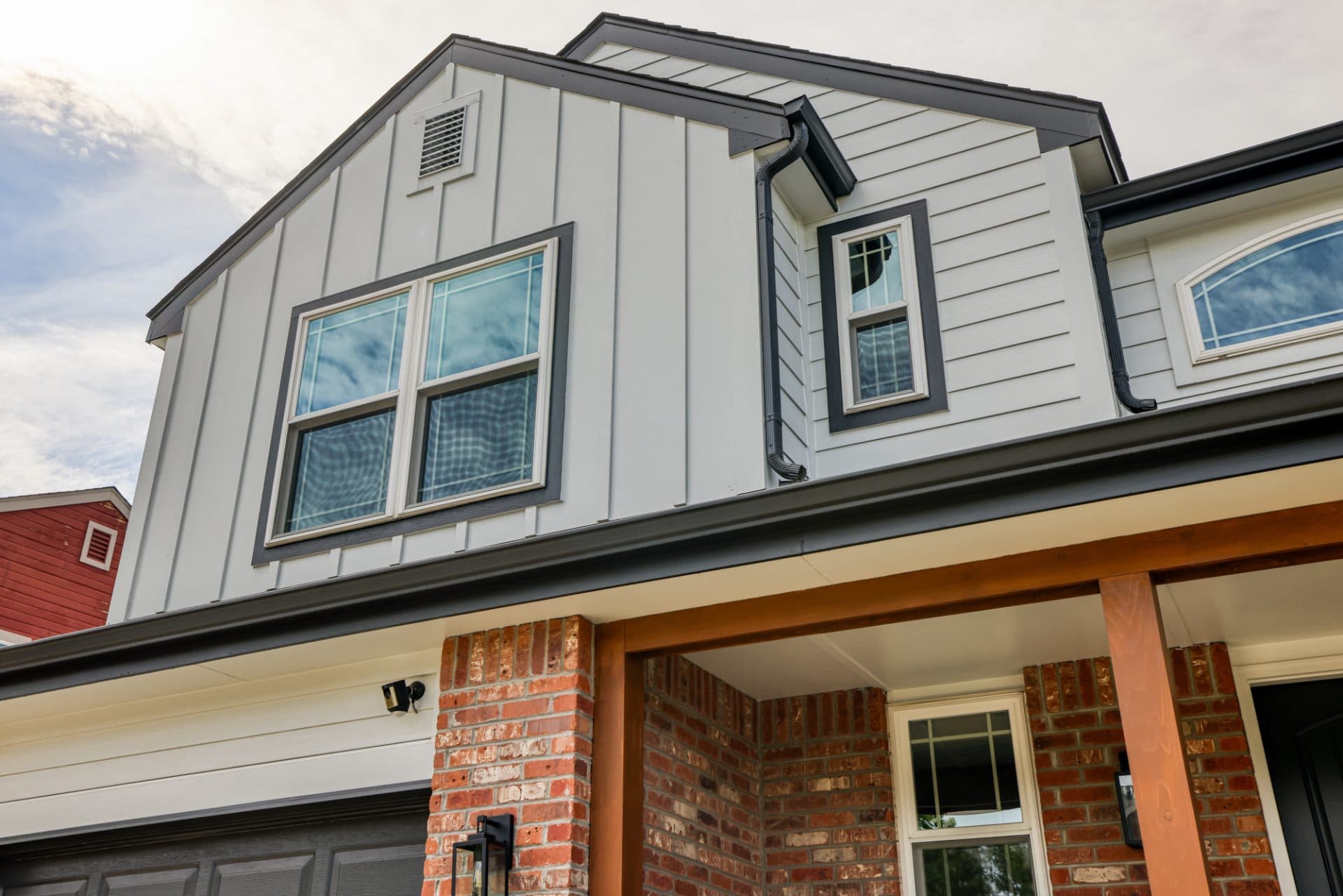
A common approach is to use lap siding on the main body of the home and board and batten on specific zones. Gable ends, a garage facade, a bump-out, or the lower portion of a two-story section. The contrast between horizontal and vertical movement adds dimension and breaks up what would otherwise be a flat, uniform exterior.
We recently completed a project in Highlands Ranch where we used both profiles together, and the combination gave the home a much more layered, intentional look than a single profile would have.
How to Think About Your Own Home
Start with your home's architecture. Look at the rooflines, the proportions, and any existing details. Window trim, porch columns, dormers. Those elements will suggest which direction makes sense.
Then think about what you want the home to feel like from the street. Taller and more modern? Board and batten leans that way. Traditional and grounded? Lap siding. A mix of both?
Color matters here too. James Hardie's ColorPlus Technology bakes the finish into the product, so the color is part of the siding itself rather than a coat of paint applied on top. That means the color you choose is going to show up consistently across both profiles, which makes mixing them easier to pull off.
Working Through the Decision Together
Our goal when we work with a homeowner on a siding project is to make sure you understand your options. That means looking at your home's architecture with you, talking through what you like and don't like about how it currently looks, and helping you think through combinations you might not have considered. We use a design visualization software so that you can try on different styles for your home. A lot of homeowners we work with come in thinking they want one thing and leave with a plan that's more interesting and better suited to their home.
If you're exploring James Hardie fiber cement siding for your home, or just trying to figure out where to start, we're happy to work through the design side of things with you. That conversation is part of what we do, not an add-on.
Frequently Asked Questions
Is board and batten or lap siding more expensive?
Board and batten costs more than lap siding for a few reasons. The material itself runs higher - wider boards with narrower battens covering the seams means more linear feet of trim. Installation is the bigger driver, though: the vertical orientation requires more precision in layout, the battens have to be individually nailed over each seam, and the whole assembly demands careful attention to expansion gaps or you'll end up with warped boards and water intrusion within a few seasons. There's also more waste in the cut patterns compared to the fairly efficient horizontal runs of lap.
Can you really mix the two profiles on one house without it looking inconsistent?
Yes, as long as the color palette and trim details tie the two together. The key is being intentional about where each profile goes. Using them in clearly defined zones -one on the main body, one on accent areas like gables or a garage - tends to look deliberate and cohesive rather than mismatched. We'd walk through the specific application with you, and we can help you visualize different options with our 3D design software.
Does one profile hold up better in Colorado's climate?
Both profiles are James Hardie fiber cement, so they share the same core durability characteristics. Fiber cement is resistant to moisture, doesn't expand and contract with temperature changes the way wood does, and is non-combustible. Those properties apply to both board and batten and lap siding equally. The profile choice is a design decision, not a durability one.
How do I know which style fits my home's architecture?
Look at the overall shape and proportions of your home first. Vertical profiles like board and batten tend to complement modern, farmhouse, and angular designs. Horizontal lap siding tends to suit traditional and craftsman styles. If you're not sure, that's exactly the kind of thing we work through with homeowners during the design conversation.
Will I need to repaint James Hardie siding the way I would with wood?
James Hardie's ColorPlus Technology products come with the color factory-applied and backed by a warranty. They'll eventually need repainting like any exterior surface, but the timeline is significantly longer than with traditional wood siding. If you choose primed-only Hardie products, they'll need to be painted after installation, similar to how you'd treat wood.