Home / Free Tools / Shingle Calculator
Free Roofing Materials Calculator
Shingle Calculator
Enter your roof size and shape to see how many squares and bundles of shingles to order, plus starter strip, ridge cap, underlayment, drip edge, and nails. Every assumption is shown. No signup, no email.
Shingle type
Roof shape (sets the waste factor)
Roof area
Enter your roof area above
Hip roof + 15% waste
Optional: edges and ridges
Eaves are the bottom edges where gutters hang. Rakes are the sloped edges at the gable ends. Used for starter strip and drip edge.
Ridges are the peaks. Hips are the sloped outside corners where two roof planes meet. Used for ridge cap.
Enter your roof area to see how many squares, bundles, and accessories to order.
How Many Bundles Of Shingles Per Square?
Roofers order shingles by the square: 100 sq ft of roof surface. Shingles are packed in bundles light enough to carry up a ladder, so it takes several bundles to cover one square. How many depends on how thick and heavy the shingle is:
- 3-tab shingles: 3 bundles per square, about 33.3 sq ft per bundle
- Architectural and Class 4 impact-resistant shingles: usually 3 bundles per square
- Heavyweight designer shingles: often 4 bundles per square, about 25 sq ft per bundle
- Premium designer and shake-look shingles: up to 5 bundles per square, about 20 sq ft per bundle
The formula is simple: roof area ÷ 100 × (1 + waste factor) × bundles per square, then round up. You can't buy part of a bundle, and running short mid-job means a second delivery and, sometimes, a color lot that doesn't quite match.
Worked Example
A 2,400 sq ft hip roof with 220 LF of eaves and rakes and 90 LF of ridges and hips, using architectural shingles:
- 2,400 sq ft ÷ 100 = 24 squares
- 24 squares × 1.15 (15% waste) = 27.6 squares
- 27.6 × 3 bundles per square = 82.8, rounded up to 83 bundles
- 220 LF ÷ 100 LF per bundle = 3 bundles of starter strip
- 220 LF + 10% for laps ÷ 10 ft = 25 pieces of drip edge
- 90 LF ÷ 25 LF per bundle = 4 bundles of ridge cap
- 27.6 squares ÷ 10 = 3 rolls of synthetic underlayment, plus about 69 lb of nails
Why A Pro Uses More Than A Calculator
A calculator gets you close enough to budget and sanity-check a quote. A real material order for a Colorado roof also accounts for things you can't see from the ground:
- Starter and ridge are measured, not guessed. We measure every eave, rake, ridge, and hip so starter strip and ridge cap come out right, not padded.
- Valleys add material. Each valley needs ice and water shield and either valley metal or extra shingles for a closed-cut or woven valley, and the cuts push waste up.
- High-wind nailing. Front Range downslope winds are a big reason shingles blow off. We use the 6-nail high-wind pattern on every shingle, placed in the manufacturer's nailing zone, which many local building departments and enhanced wind warranties require.
- Hail. Class 4 impact-resistant (UL 2218) shingles hold up far better in Denver hail, and many Colorado insurers offer a premium discount for them. Most still pack 3 bundles per square.
- Decking and tear-off. Soft or rotted decking only shows up once the old roof is off, and it has to be replaced before new shingles go down.
Learn more about asphalt shingle roofing and what goes into a full roof replacement, or get your starting number with our roof size calculator by address.
Frequently Asked Questions
How many bundles of shingles in a square?
Most 3-tab and architectural shingles, including Class 4 impact-resistant lines, come 3 bundles to a square. A square is 100 sq ft of roof. Heavier designer and shake-look shingles are often 4 or 5 bundles per square. The bundle wrapper lists its coverage, so check it before you order.
How much does a bundle of shingles cover?
A standard 3-bundle-per-square shingle covers about 33.3 sq ft per bundle. A 4-bundle product covers about 25 sq ft per bundle, and a 5-bundle product about 20 sq ft. Starter strip and ridge cap are sold by linear foot instead, usually 100 to 120 LF and 20 to 33 LF per bundle.
How much extra shingles should I order for waste?
Plan on about 10% extra for a simple gable roof, 15% for a hip roof, and 20% or more for a cut-up roof with valleys, dormers, and several pitches. Waste covers the cut-offs at hips, valleys, and rakes, plus a few spares to keep for future repairs.
How many squares of shingles do I need?
Divide your roof area in square feet by 100, then add your waste factor. A 2,400 sq ft roof is 24 squares before waste and 27.6 squares with 15% waste. Measure the roof surface, not the house: a 2,000 sq ft two-story home can have a much smaller roof than a 2,000 sq ft ranch.
How many bundles of shingles do I need for a 2,000 sq ft roof?
With a standard 3-bundle-per-square shingle, a 2,000 sq ft roof needs about 66 bundles if it is a simple gable (22.0 squares with 10% waste) or 69 bundles if it is a hip roof (23.0 squares with 15% waste). Add starter strip and ridge cap on top of that.
How many nails per shingle in Colorado?
Manufacturers call for 4 nails per shingle in a standard installation and 6 nails in their high-wind application. Along the Front Range, where downslope winds regularly gust past 70 mph, we nail every shingle with 6 nails, and some local building departments and enhanced wind warranties require it. That works out to roughly 2.5 lb of 1-1/4 in. roofing nails per square.
Do I need starter strip and ridge cap shingles?
Yes. Starter strip runs along the eaves, and usually the rakes, under the first course so the edge seals down and resists wind lift. Ridge cap covers the peaks and hips. Both are separate products from your field shingles, and cutting up field shingles instead can void a manufacturer's enhanced wind warranty.
Want An Exact Material List?
A free, in-person estimate takes about 30 minutes. We measure every ridge, hip, valley, and edge, so the shingle order is right the first time and the price is in writing.



Finding a good contractor
shouldn't be hard
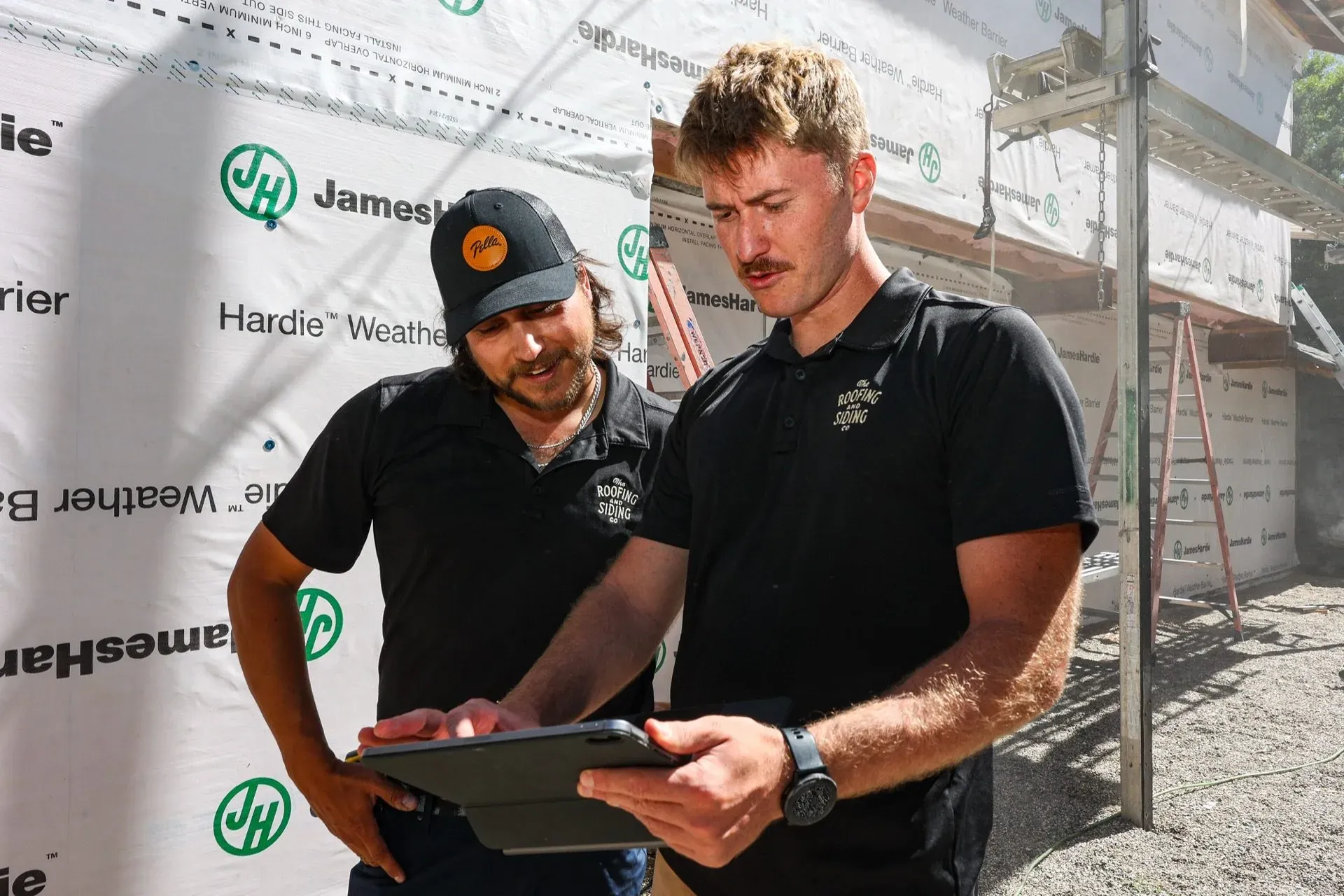
Living with a damaged roof or failing siding is stressful enough. But often, the 'fix' feels worse than the problem. The last thing you need is a pushy salesman trying to rip you off or a disorganized crew that you're forced to babysit because they won't communicate.
That's why we focus on making this process easy for you. Our professional team will provide the high-quality results you expect while keeping you informed every step of the way. Homeowners rate us 5 stars because we treat you and your property with the care you deserve.
Elite means vetted
A James Hardie
Alliance Elite Contractor
Factory-trained, quality-audited, and backed by the #1 name in fiber cement siding. When James Hardie puts their badge on our work, you can put your trust in it.
Explore James Hardie Siding